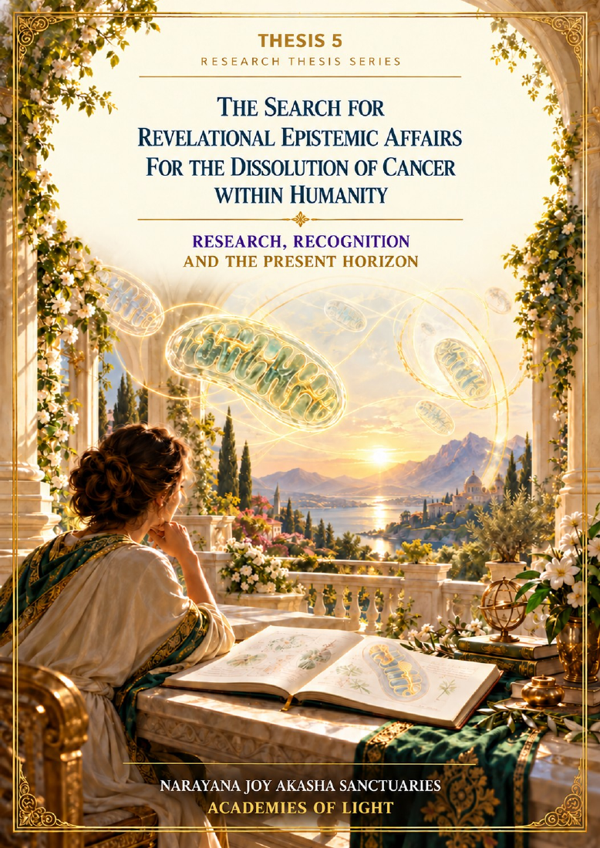
Thesis Five
The Search, Recorded Honestly
Research, recognition and the present horizon — what the search for a cancer cure found, what it did not, and where it now stands.
Thesis Five carries the work of Thesis Three and its Educational Guide into one of the most painful questions of our time: whether anything already known, published or patented points toward the dissolution of cancer within humanity. It is written for the general public, for carers and families, and for medical practitioners and scientists who are open to new ways of thinking. Its discipline is simple and held from the first page to the last: every finding is reported for exactly what it shows — no more, and no less.
The book opens by introducing the architecture readers meet throughout this series: the Nine Cosmic Laws, the Twelve Fields of Translation, the Twelve Human Approaches and the 108 Relationships of Embodied Consciousness, each shown first as its own Wheel and then joined. The Laws and Relationships are offered as spiritual principles for contemplation and are kept clearly apart, at every turn, from any claim of medical effect.
The research itself is a focused review of published work rather than a laboratory programme. It begins with studies in which certain specially made vanadium compounds disrupted the mitochondria of pancreatic cancer cells and led to cell death, and widens to patent searches, a preclinical ivermectin and gemcitabine result, an electric-field treatment device approved in 2026 for use with chemotherapy in locally advanced pancreatic cancer, and the many ways pancreatic tumours adapt in order to survive. Each is set out with a plain statement of what it does, and does not, establish.
Two further reviews follow. The noetic review looks at biofield and intention research — including a 2026 laboratory study of biofield therapy on pancreatic cancer cells — alongside results that did not confirm a proposed effect, the contribution of human studies, and accounts of spontaneous remission. The whole-food review asks what food research can and cannot show, checks specific claims against their sources, and proposes carefully designed food studies for qualified research teams to carry out.
Its honest conclusion is that no cure was found through any of the avenues investigated. The search identified real and useful research questions — in mitochondrial biology, dietary fibre and the gut, food preparation, and measurable physical treatments — but did not find that thoughtforms, radionics, crystals, a particular food, ivermectin or any transferable substance offers a universal means of dissolving human cancer, nor that consciousness alone reliably removes tumours. Several avenues merit further research; none is a reason to replace effective medical treatment.
Where the search for a scientific cure reaches its present boundary, Thesis Six begins: a companion for the person living through the experience of cancer, offered alongside medical care.
The Four Wheels of this Thesis
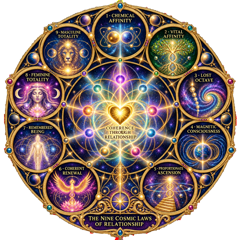 The Nine Cosmic Laws
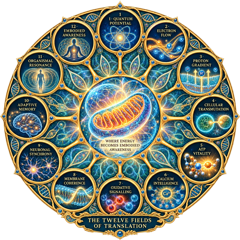 The Twelve Fields of Translation
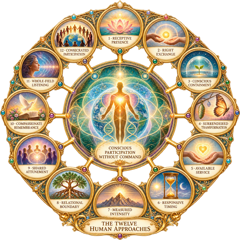 The Twelve Human Approaches
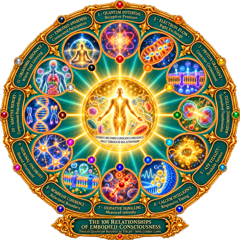 The 108 Relationships
These Theses are offered for education and contemplation. They are not medical advice, do not diagnose or treat any condition, and should never be used to delay, replace or change treatment recommended by a qualified clinician.
If you would like to reach us directly, please write through Inner Reception.
Watch · A Short Video Overview (8 min)
Listen · The Full Podcast (20 min)
Download the full podcast (20 min)
Read · The Full Thesis · Free PDF