


Wheel Four of Thesis Nine · The Methods of the Twelve Modules
Twelve ways of meeting, offered as Formulae of Approach.
Wheel 4 of 4 · from Thesis 9 — The Living Human Christ Council.
Nine Laws, twelve Wellsprings, twelve Ripples and twelve Oases: within every Module, the Wellspring is the heart, the Ripple is the scene, the Oasis is the method and the Law is the lens.
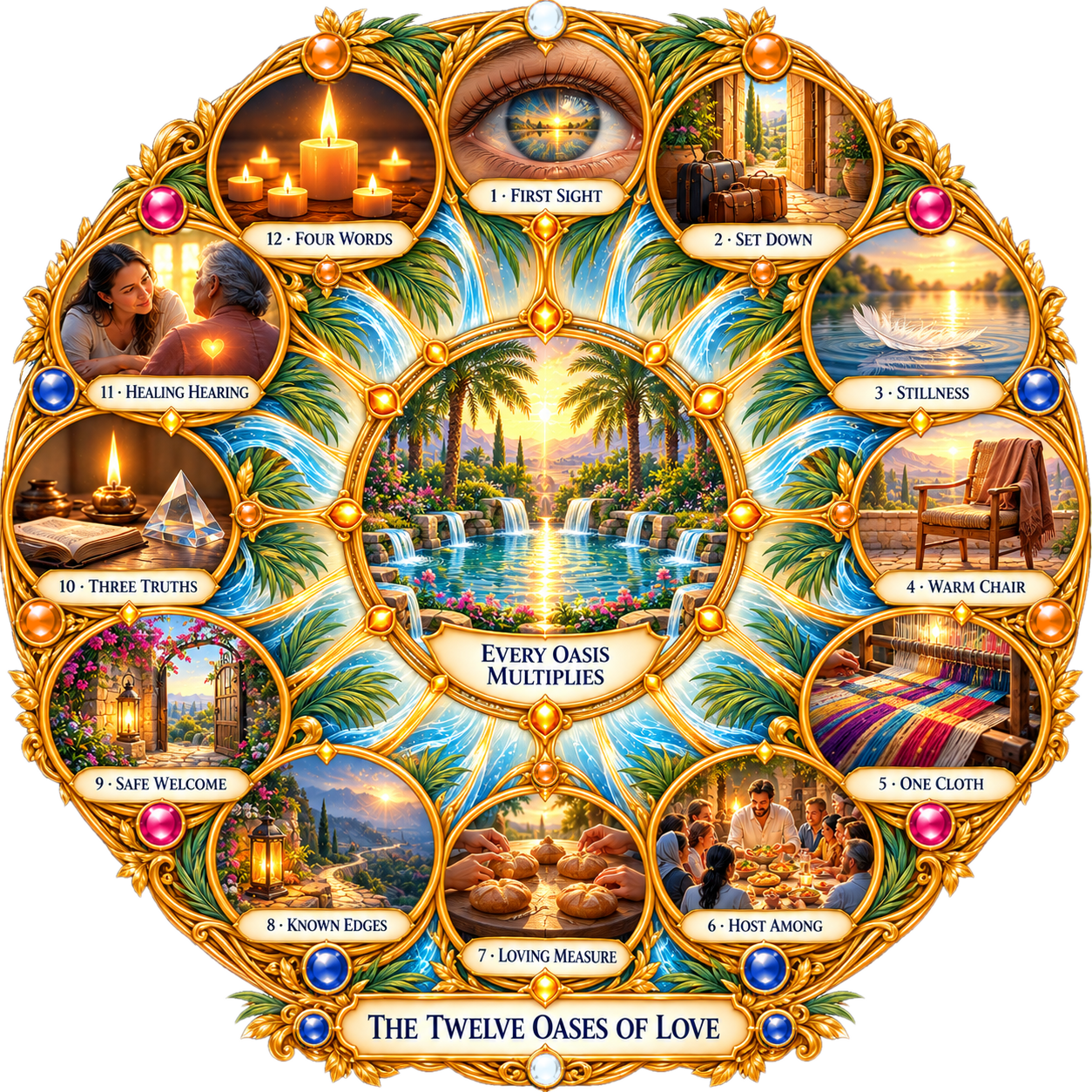
The twelve Oases are the methods of the twelve Modules: ways of meeting, drawn from the Compassionate Affairs Petition recorded in Memras 9 and 10, that break patterns in which not everyone can take part or in which bias controls the outcome. Each is offered as a Formula of Approach, discovered through practice rather than imposed. The hub of the Wheel is Every Oasis Multiplies: each well-held meeting makes the next one easier, and in time such meetings become the ordinary way.
1 · First Sight — Seeing as for the First Time
Members are invited to meet each person and each matter as if for the first time, without the labels they arrived with: “as a Child looks at a thing for the first time, not knowing its name or what it is used for.” It releases the pattern in which people and issues are decided before they are met. (Memra 9)
2 · Set Down — Setting Down the Suitcases
Before a gathering begins its work, it makes room to set down what its members are carrying: old roles, losses, disappointments, agendas. “Grieving is clinging to that which has been lost, mourning is the act of letting go!” It releases the pattern in which unspoken burdens steer the meeting. (Memra 9)
3 · Stillness — Speaking into the Stillness
A question is read twice so that it is heard fresh. Each person speaks once, “into the space, without reply or rebuttal,” and silence is allowed to hold what has been said. It releases the pattern of debate, in which the quickest and most forceful speakers shape the outcome. (Memra 10; Memra 9)
4 · Warm Chair — The Chair Kept Warm
A place is kept in the circle for the one who cannot come, named and honoured throughout: “Her place in this circle remains.” Where possible, the gathering goes to them. It releases the pattern in which those who cannot attend are treated as having nothing to say. (Memra 10)
5 · One Cloth — Many Threads, One Cloth
Members reflect privately and submit what they have found; one person gathers the contributions and they are shared with the group as a single, unattributed Group Sharing before any direction is set. It releases the pattern in which status decides whose idea is heard. (Memra 9)
6 · Host Among — The Host Among Us
The host steps down from the front, sets the microphone on the table and moves among those gathered, putting the question to the room “to open a brief space for recognition” rather than for argument. It releases the pattern of the raised platform, in which a few speak and many only listen. (Memra 10)
7 · Loving Measure — Enough, Measured by Love
Allocation is guided not by fixed lines but by a living measure, kept alive through conversation and sharing: “One needs no more than they can Love.” It releases the pattern in which rules of allocation outlive the needs they were written for. (Memra 9)
8 · Known Edges — Wisdom That Knows Its Edges
Contributors are chosen for responsibility rather than prestige, kept different on purpose, and asked to “speak from experience, not opinion,” saying what their way of knowing does well and where it reaches its limits. It releases the pattern in which one discipline’s blind spots govern everyone. (Memra 10)
9 · Safe Welcome — Nothing Asked, Nothing Taken
Before anyone speaks, a promise is offered to whoever comes carrying most: “Nothing will be taken from you. Nothing will be demanded of you. Nothing will be used against you.” No one is asked to tell their story; silence is as welcome as speech. It releases the pattern in which the most affected are least safe to speak. (Memra 10)
10 · Three Truths — Spirit, Mind and Science at One Table
No gathering rests on one kind of knowing. Spiritual, philosophical and scientific understanding, the last “including the arts and crafts,” are seated together so that each can temper the others. It releases the pattern of fragmented learning, in which one kind of expertise rules alone. (Memra 9, St Germain)
11 · Healing Hearing — The Hearing That Heals
A hearing is framed as restoration rather than condemnation, after the Hebrew word mishpat, which, the teaching says, “refers to redemption and vindication, not to accusation and condemnation.” The inquiry may question its own form, and may close with the record left open. Those who were harmed are heard without being required to forgive. It releases the pattern in which hearings exist to find someone guilty. (Memra 9; Memra 10)
12 · Four Words — The Four Healing Words
Adversaries are seated at one table without preconditions, for “There are no enduring enemies, but there are adversarial situations.” They are invited to speak four statements drawn from Ho’oponopono, the traditional Hawaiian practice of reconciliation: “I Am Sorry, Please Forgive Me, Thank you, I Love You.” The words are offered, never required, and no one is asked to reconcile before they are ready. It releases the pattern in which peace is negotiated only between those who first agree to be enemies. (Memra 9)
Part of the four Wheels of Thesis Nine, where the video, the full podcast and the complete Thesis as a free PDF are found. Quotations are short and credited, as in the Thesis itself.
If you would like to reach us directly, please write through Inner Reception.