Book I · The Confluence, Part One
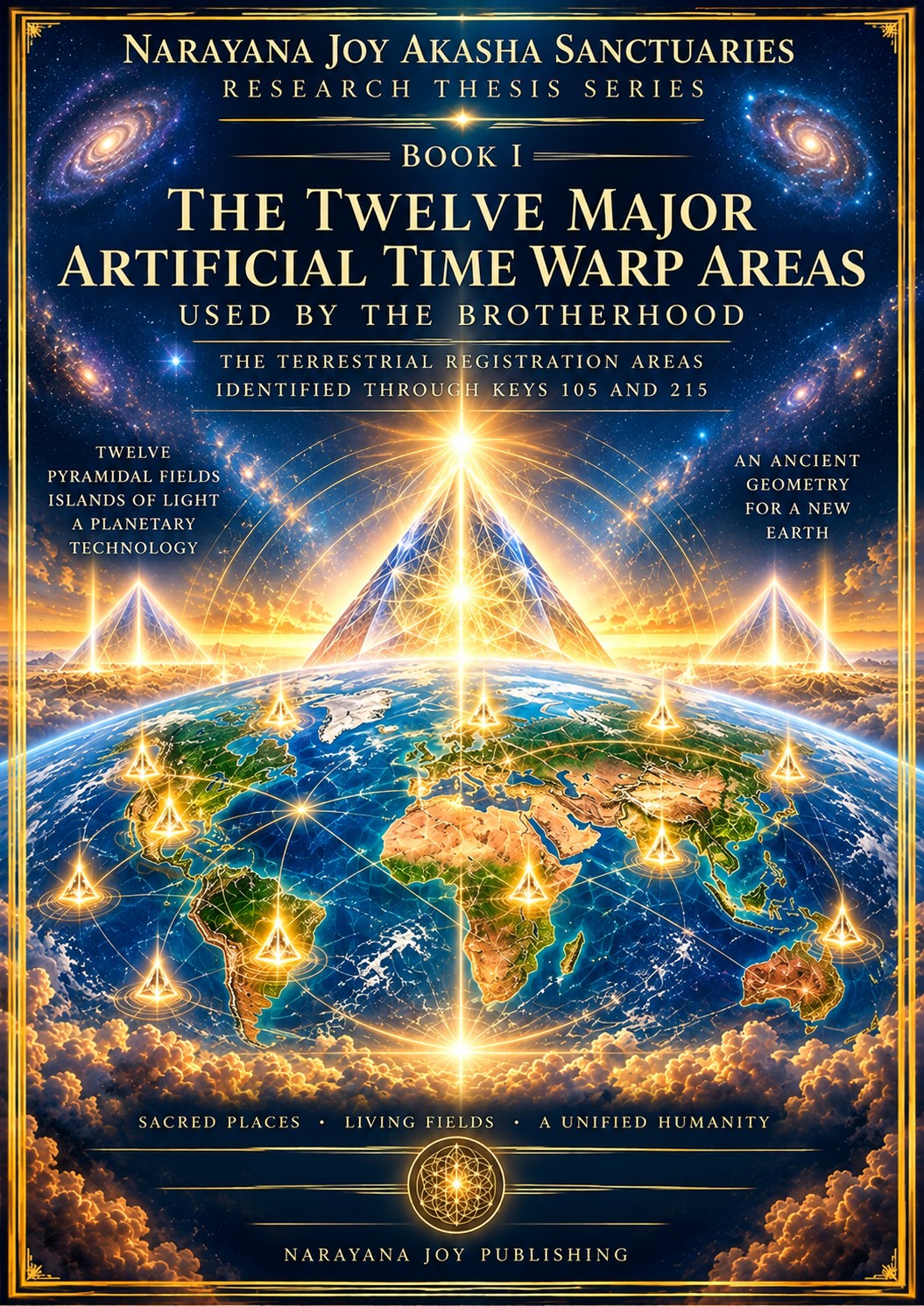
The twelve Major Artificial Time Warp Areas, reconstructed from Keys 105 and 215 and tested against the physical Earth.
Thesis One asks a plain question with an unusual history: can a body of channeled instruction, drawn chiefly from J. J. Hurtak's Keys 105 and 215, actually be reconstructed on the physical Earth with enough precision to be tested, not merely believed? The inquiry did not begin as an attempt to prove Hurtak right. It grew out of an already-developing NJAS concern with sacred place and Pyramidal Light architecture, and the practical question of how a Sanctuary could be situated within a living planet without reducing sacred geography to inspirational approximation.
The discipline set for that question is unusually strict for a work of this kind. Evidence, corroboration, contradiction and unresolved material are kept deliberately distinct throughout; a source statement is never strengthened by dressing it up as a scientific claim the source did not make, and a mathematical correspondence is never treated as proof merely because the residual happens to be small. Three registration classes — POINT, FIELD and CORRIDOR — are used to say plainly how confidently any one Area's location is actually known, rather than letting every finding read with the same borrowed certainty.
Key 105 supplies the twelvefold planetary architecture and the distinction between Natural and Artificial Time Warps; Key 215 supplies the Great Pyramid's own coordinates and the 27.7° eastward setting-out angle that seeds a bearing-and-distance test from Giza to each of the eleven other Artificial Areas. Giza itself is the datum and closure point for the whole reconstruction — not a discovery to be proven, but the fixed origin every other Area is measured against. From that origin, a 6′ longitude and 7.5′ latitude lattice is laid across the Earth, and each candidate Area's coordinates are tested against it directly: a nearest-six-minute residual, honestly reported as a descriptive registration value rather than a stand-alone statistical proof.
Twelve Artificial Time Warp Areas are tested this way in turn, from Aral Sea–Kungrad through Takla Makan, the Philippines, Kwajalein, Hawaii, Vancouver Island, Pueblo, Lexington, Nova Scotia, the Azores, Lourdes and back to Giza itself. Each Area gets its own chapter and its own findings; Kungrad stands as the explicit calibration case, and the broader Areas are candidly flagged as retaining coordinate-selection sensitivity rather than being asserted as settled fact. The completed terrestrial map that results is not treated as the completed field. It answers only where the source architecture can be registered upon the physical Earth — not when a field is active, how far it extends vertically or radially, how it answers to magnetic or celestial conditions, or what part Human consciousness plays in its activation. Those questions are named openly as belonging to a second field of orientation, carried forward rather than glossed over.
That second field is where Book I's second half turns. From location, the Thesis moves to field: the Pyramid is treated not as a point on a map but as a three-dimensional structure with its own sphere of influence, and the Bio-Graviton Light Pyramid architecture is introduced as the model for how that field actually behaves. A single scale exemplar makes this concrete: Giza's own field, roughly half a square kilometre at its base, is joined by Bucegi at four times Giza's scale, Tarim at twelve times, and Megiddo at one hundred and forty-four times — over a thousand square kilometres. The Light Pyramid principle allows for this scaling without an imposed metaphysical ceiling, but each individual calculation is still required to declare a finite centre, orientation, footprint, apex and scale of its own; unlimited possible scale is never read as unlimited evidential tolerance.
From field, the Thesis turns to magnetism, time and consciousness directly — the magnetism of spheres, the question of time clocks and time cells, and finally Human consciousness within the field itself. Here the Gene Keys spectrum of Shadow, Gift and Siddhi is offered as a comparative consciousness lens, not a replacement for the Nine Cosmic Laws that remain the Thesis's own organismal foundation throughout. At the Shadow level, sacred architecture is reduced to an external object and the Human Being remains a detached observer; at the Gift level the relationship becomes dynamic, through coherence, responsiveness and conscious participation; at the Siddhi level, the very boundary between operator, structure and the greater field is held as synthetic unity. Book I is read as travelling a related arc in its own right — beginning in the discipline of physical placement, moving through relational field and Pyramidal architecture, and closing in Human consciousness and Cosmic Law — without ever needing the two systems to be made identical.
Book I does not close by choosing between mathematics and consciousness. Its stated purpose is to bring each to the limit of what it can truthfully contribute: the terrestrial field reconstructed, calculated, mapped, challenged and made visible; and the Human-consciousness field restored to its rightful place as participant rather than afterthought — not a device for repairing failed coordinates, but an originating dimension of the Higher Work through which physical structure may become living relationship. A reader committed solely to conventional measurement is given source control, arithmetic, coordinate provenance, rejected hypotheses and full technical mapping, sufficient to reproduce the physical investigation without being asked to accept the Higher interpretation. A reader working through consciousness, Cosmic Law and multidimensional participation is never asked to pretend the measurable surface exhausts the field. Neither orientation is made subordinate to the other.
That refusal to flatten the work into a single register is, in the end, the whole architecture's own governing proportion — geodesy and revelation held side by side rather than one absorbed into the other. The maps show where the terrestrial architecture registers. The multidimensional model asks what happens when a Human Being enters that registered field consciously. And the field protocols this Thesis proposes convert that question into an actual programme of observation, in which electromagnetic, environmental, physiological, temporal and consciousness-related variables can, in time, be studied together.
Book I's own twelve Artificial Time Warp Areas already have their own pages on this site, gathered together in the Artificial Time Warp Wheel; this page is the Book's front door — the terrestrial reconstruction told as a single, continuous piece, before the reader steps into any one Area's own chapter. Book II, The Natural Time Warp Areas, carries the same discipline into the second half of the Confluence; Thesis Three carries it further still, into the living cell.
If you would like to reach us directly, please write through Inner Reception.
Listen · A Companion Podcast
Download the audio · GPS Precision for Artificial Time Warps (39 min)