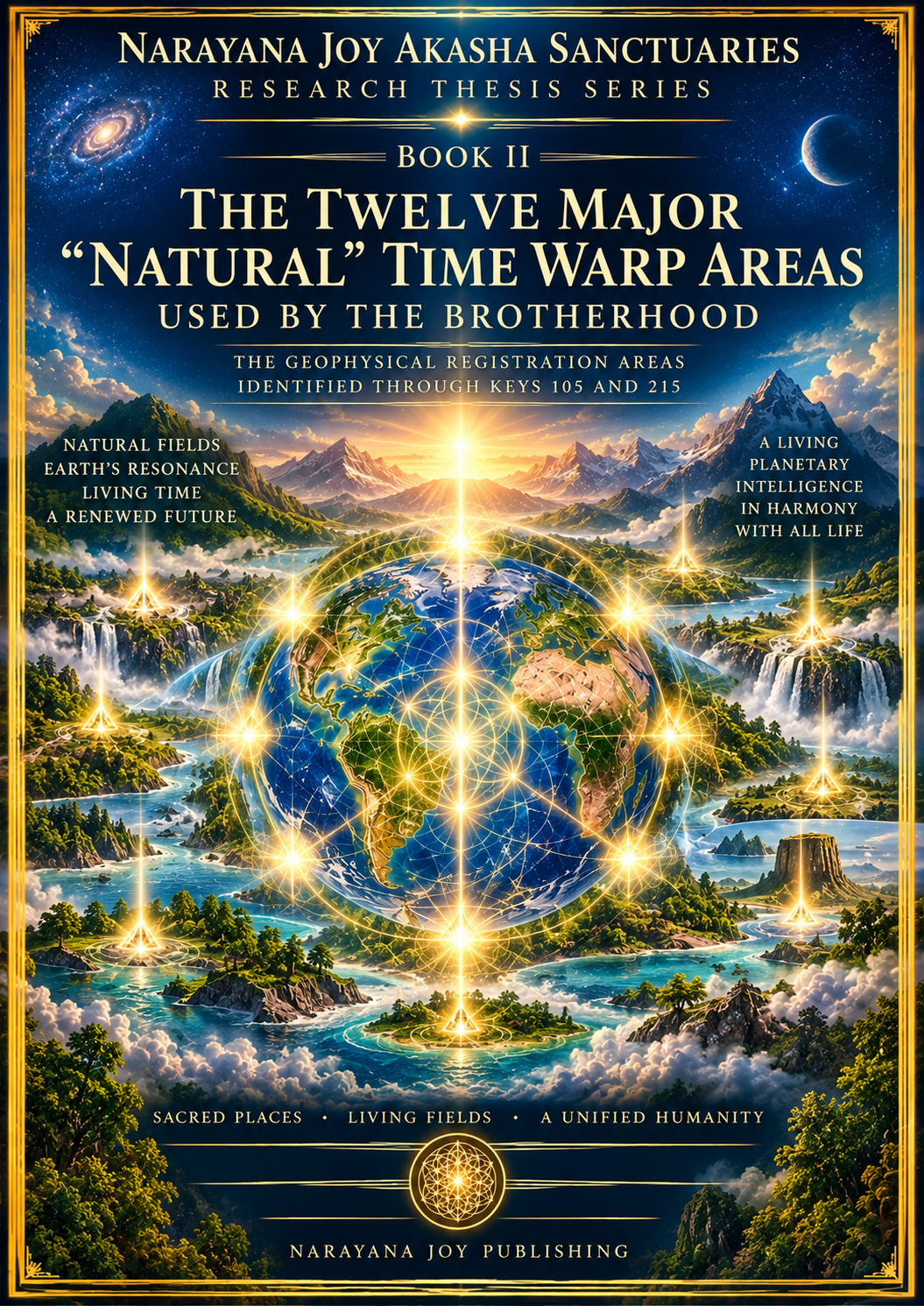
Book II · The Confluence, Part Two
Twelve Natural Areas, tested against Key 105 with the same discipline Book I established for the Artificial Areas.
Thesis Two carries the same governing discipline that opens Book I into the second half of the Confluence: the Natural Time Warp Areas, examined to the identical standard, using the identical source, and refusing every shortcut that would make the second Book's findings sound stronger than they actually are. "A source statement is not strengthened by dressing it as science," the Book states early on, "and an HVR recognition is not strengthened by dressing it as mathematics" — the two are kept as deliberately separate as a compass needle from the map it is laid upon, because each is only useful for as long as it does not pretend to be the other.
Where Book I tests eleven Artificial Areas against a bearing-and-distance instruction seeded by Key 215, Book II works from Key 105 alone. Twelve Natural-candidate Areas are identified — Giza itself, Cape Town, Wilpena Pound, Takla Makan, the Black Sea, Great Salt Lake, Fátima, the South Atlantic Anomaly, Lake Titicaca, On (Heliopolis), the Bermuda Triangle and Jerusalem–Hebron — and each is tested the same way Book I established: Giza's own meridian fixed at 31.150000°E, longitudes unwrapped into a continuous eastward circuit so "eastward" never silently becomes "nearest," and each Area's displacement measured against a 6′ longitude / 7.5′ latitude lattice frozen from that datum. The resulting residuals, gathered in the Natural Longitude and Natural Latitude Registers, are reported candidly rather than dressed up: Giza's own residual sits at under a minute, most Areas fall within a few minutes either way, and the Book is explicit throughout that a small residual is a registration value, never a stand-alone proof.
What makes Book II distinct is not only its Areas but its willingness to examine its own limits in public. An entire section — Adversarial Review — is given over to falsification, null expectation and the kind of challenge a genuinely sceptical reviewer would raise, rather than folding that scrutiny quietly into a footnote. A related honesty runs through the appendix where a direct question is asked and answered without flinching: does Book II actually draw on Key 215 the way Book I does, as its own cover claims? The honest check finds that it does not — every one of the twelve Natural Areas is identified through Key 105 alone, and Key 215's specific contribution, the 27.7° eastward setting-out angle, has no equivalent step in Book II's own lattice-based method. Rather than quietly editing the cover or leaving the gap unaddressed, the Book adds a genuine Key-215-style bearing-and-distance figure to each of the twelve Areas, computed independently via a WGS84 geodesic from Giza, as a supplementary cross-check standing alongside the primary lattice test rather than replacing it. It is a small moment, but it says plainly what kind of research this claims to be: corrected in the open, not polished after the fact.
Beyond the twelve Areas, Book II turns to a Natural-field numbers hypothesis centred on the South Atlantic Anomaly — the one place on Earth where the planet's own magnetic field is measurably weaker than anywhere else, examined here as a possible Natural-field counterpart to the numerical patterns Book I considered and ultimately set aside for its own Artificial Areas. What is actually published on the Anomaly, what a proposed test would need to show, and what the genuine finding actually demonstrates are each treated as separate questions, worked through in sequence rather than allowed to blur into one triumphant conclusion.
Consolidated findings return the Book to Giza and close its own coordinate work with a full Longitude Register, a Latitude Register, and the 360° eastward closure that ties the twelve Natural Areas back into a single continuous circuit around the Earth, exactly mirroring the discipline Book I completed for its own twelve Artificial Areas.
From there the Book turns, as Book I does, from location toward field. The Moving Electromagnetic Earth introduces epoch as a genuinely new Natural variable — the recognition that Earth's own field is not static, and that a Sanctuary's or a terrestrial reference's registration against the 6′ × 7.5′ architecture can shift as the planet's own electromagnetic condition changes around it. The Sliding Light Pyramid carries the same scale principle Book I introduced at Giza, Bucegi, Tarim and Megiddo into a Natural-field register, and one of Book II's later chapters offers what may be its most memorable image: HVR — Human Vibrational Resonance, the term this whole site returns to again and again — set alongside the honeybee. A hive remains one living identity even as its members move, its nourishment changes, the weather changes, and disturbance introduces static into its rhythms. Identity, in other words, is carried through relationship and renewed coherence, not through the stillness of every part holding its position. HVR is treated with the same discipline as everything else in the Book: a proposition about Human higher-consciousness resonance, explicitly not a substitute name for heart-rate variability or any other conventional physiological measure that happens to share its initials.
The Nine Cosmic Laws are brought fully into the Natural architecture in the Book's later chapters, the same organismal foundation Thesis One and Thesis Three both rest on — proof, here, that the Confluence really is one grid-logic read in two registers, Artificial and Natural, rather than two unrelated projects sharing a cover design. And the Book's own closing insistence, carried from Book I and repeated here without softening, is that evidentiary weight rests on an Area's source provenance, its spatial-class honesty and its own chapter's declared findings — never on residual smallness alone.
Book II's twelve Natural Areas already have their own gathering point on this site, in the Natural Time Warp Wheel; this page is the Book's own front door, telling that reconstruction as one continuous piece before the reader steps into the individual chapters and briefs. Book I, the Planetary Time Warp Architecture, carries the Artificial half of the same Confluence; Thesis Three carries both halves further still, into the living cell itself.
If you would like to reach us directly, please write through Inner Reception.
Listen · A Companion Podcast
Download the audio · The Mathematics of Twelve Natural Time Warp Areas (45 min)